Share article
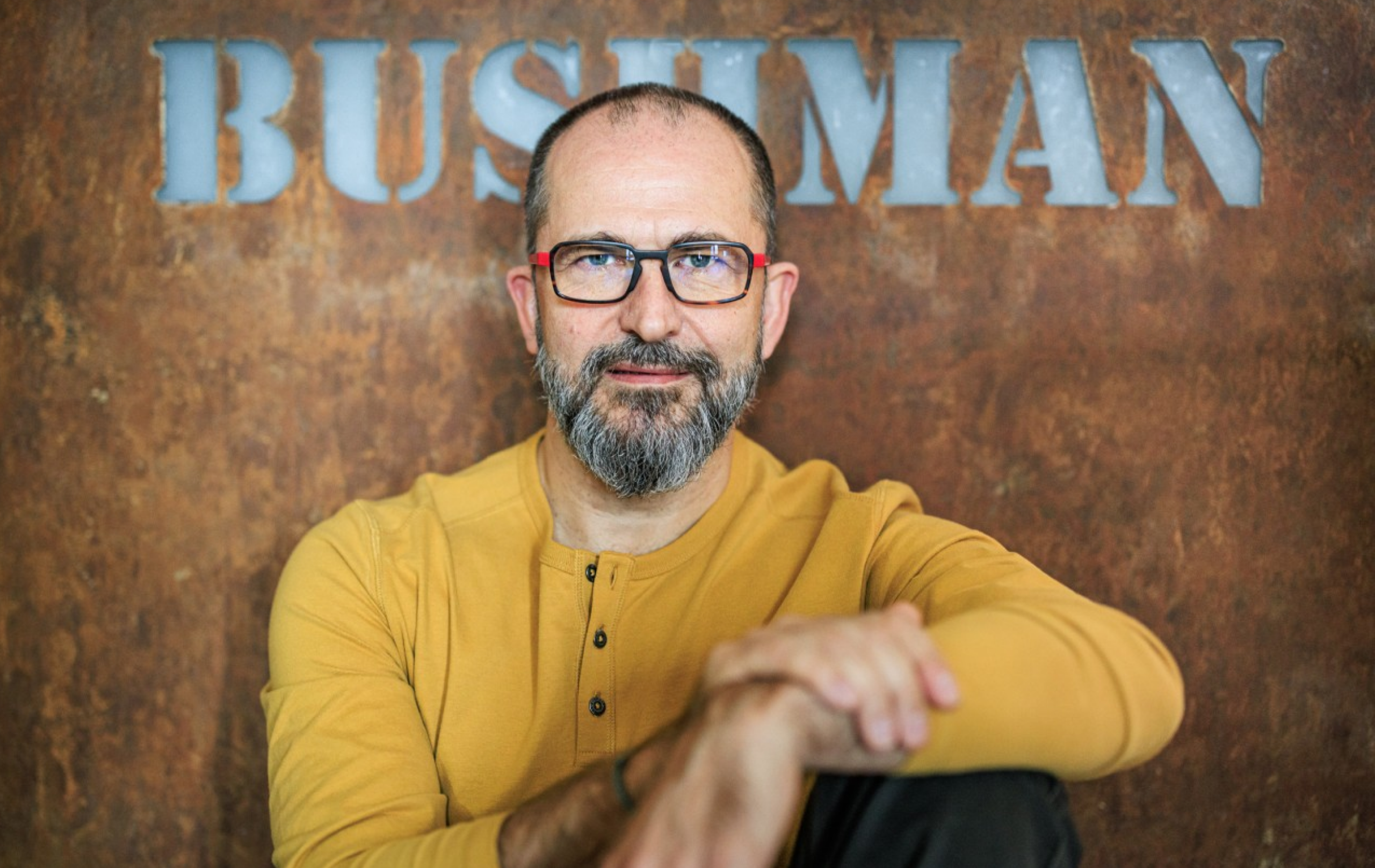
Bushman was founded in 1997, when Jindřich Melichar, wandering around Australia, realised that travellers need not just quality gear but also comfortable clothing made from natural materials. From four people in a Prague office in Smíchov grew a brand that today sells through its own network of shops and an online store in the Czech Republic and other European countries.
Petr Hulec has been at the helm of the company for eight years now, and he’s one of those taking Melichar’s original vision even further, with an emphasis on authenticity, natural materials and a close relationship with both customers and employees.
Before we get into the serious stuff: I read in Forbes that you first wore Bushman in Peru, long before you became its boss. What does the brand mean to you now, after six years at the helm?
Time really flies — this year marks my eighth at the helm. As a brand, Bushman is incredibly distinctive, with its own DNA, an interesting story and huge potential. I think it has what it takes to become a truly global brand one day. Even though Bushman will turn 30 next year, I see it as a teenager coming out the other side of puberty — most of the escapades are behind it, it’s starting to sort out its priorities and direction, and it’s heading into its next chapter with youthful energy.
You told me that instead of NPS and CES, you rely more on breakfasts with employees. What do you learn over coffee that no spreadsheet could tell you?
Honestly, sometimes I learn more than I’d like to 😊. We got to the breakfasts gradually. I wanted to find a way to draw in the people who make up the brand, so they’d have a fuller picture of how the company works as a whole, not just their own department. At first we sent everyone a monthly report on results and what was happening across departments. It worked for a while, but it got harder and harder to get one department to write its contributions, and I had no proper systematic feedback from the employees reading the reports. So more than a year ago we set up a routine: on the first Wednesday of every month, everyone except the shop assistants meets in the tearoom — what we call our biggest common room — for a breakfast we prepare together, and we talk openly about what we’ve been through, what worked, what didn’t, and what’s coming next. Everyone gets the chance to share how they feel, air a grievance, or suggest changes that would make sense to them.
These breakfasts don’t give me any hard data or a score, but they tell me very precisely what the current mood in the company is and what’s bothering people. On top of that, I think employees feel a greater sense of belonging to the company and take on responsibility more readily as a result.
I’m also curious about your “soft reports” from the shops no scores, just gut feeling. What actually happens with a report like that afterwards?
Every shop sends head office a monthly report. There isn’t a single number in it. We want the perspective of the shop assistants who serve customers every day — why some products sell well and others flop. We often find the reasons are completely different from what we assumed at head office. In these reports, the assistants also praise or tear apart our marketing campaigns, and there’s a section with customer wishes and comments too.
We read the reports at head office, discuss them, and try to draw real conclusions from them — ones that actually reach as far as Production or Marketing.
Petr, you said the only hard numbers you track come from reviews both product reviews and reviews of the brand itself. What happens the moment a bad review comes in?
Our customer service reads absolutely every review, and for negative ones they try to identify the specific order behind it. If they manage to work it out from the clues, they contact that customer directly and deal with their problem individually. Customers are often pleasantly surprised that we reach out to them ourselves and want to sort things out. Quite often they then adjust their negative comment themselves, or delete it entirely. Personally, I keep a regular eye on the score, and if the shop’s recommendation rate drops below 99%, or overall satisfaction with the shop falls below 4.9 out of 5, I dig deeper into the reviews and try to find the cause or a systemic issue.
Bushman got through Covid partly thanks to a clothing voucher scheme and employees voluntarily taking pay cuts. Do you think people’s love for the brand can be captured in any way, or is that exactly the kind of thing that can never be reduced to a number?
We more or less sense that Bushman is a genuine lovebrand for a lot of people. The degree of love for the brand, whether from customers or employees, can’t be expressed in a number or a score, but you feel it very tangibly in moments of crisis, when customers or employees stand by you. Not because it benefits them, but unconditionally, because that’s simply how they feel. This is actually one of the reasons I see real meaning and huge potential in Bushman.
Today you have physical shops, an online store and eight international domains. Where have you personally had to add more structure, now that you can no longer physically know every customer or every employee?
The secret lies in the whole ecosystem. Our basic premise is that there’s only one customer, and the sales channel is just a route to the product. Our goal is to make that route as simple and pleasant as possible for the customer. Choose online and collect in-store, because you want to try it out before paying; or come and feel the material in the shop, then order online and have the parcel delivered to a locker or your home. We’re removing obstacles that could put the customer off, and steering them towards whatever they need.
If I said we don’t chase hard data on customer satisfaction all that much, sales data is a different story — we’re extremely interested in that. We gather it from every possible channel, store it against individual customer accounts, and then dream up all sorts of clever segmentation tricks on top of it. I think that’s a trend that will resonate more and more with business as AI takes hold.
Alongside regular customers, you also clothe people from zoos, botanical gardens and national parks. Do you handle anything differently with them compared with someone popping into a shop to buy a T-shirt?
Yes and no. Yes, in terms of customisation and keeping contracted products in the same colour shade, cut and material composition throughout the whole contract period, sometimes for several years. But fundamentally, they’re the same kind of customers to us as the people who come into our physical shops or shop online. They have the same needs — the clothing has to be comfortable, practical, and has to last a long time.
You have quite an interesting line-up of ambassadors Jakub Vágner, people from the caravanning world, from the Dakar Rally. Do you see this purely as marketing, or are these people who genuinely speak to customers on your behalf?
Above all, they have to be people who wear Bushman not because it’s some business deal, but because they genuinely want to wear it. Most of our ambassadors are already our mates, and they don’t just represent us — they also test our clothing in extreme conditions. That might actually be even more valuable than the ambassadorship itself. They give us honest feedback, and that helps us improve our collections.
Back in Jindřich Melichar’s day, Bushman was known for politically engaged prints too. Do you carry that on under your leadership, or have you moved away from it?
Bushman has always been engaged in some way — I think it’s somehow part of our DNA. It’s true that Jindra pushed for more politically engaged prints. I probably don’t go to such extremes, but when I feel we need to speak up on some issue, I’ve no problem putting out a more controversial print. Personally, though, I get more involved in value-based issues. Either way, we still get plenty of hate mail, so we can’t complain 😊
Authenticity comes up again and again in your interviews as the key to surviving against cheap fast fashion. Can authenticity be deliberately built, or is it simply the result of a company being run by people who believe in what they do?
I don’t think authenticity can really be artificially manufactured — it either exists or it doesn’t. It grows out of established, deeply held values, and it draws people who share those values towards you like a magnet. Through their work, those values then bubble back up through the products and the communication, out into the world. And yes, I still believe authenticity is one of the few things that still lets quality brands survive alongside consumption-driven fast fashion brands.
If you had to sum up your approach to customers in one sentence that X Pulse readers could stick on their monitor, what would it be?
Always look for a way to delight the customer, and remember that the search never ends.