Share article

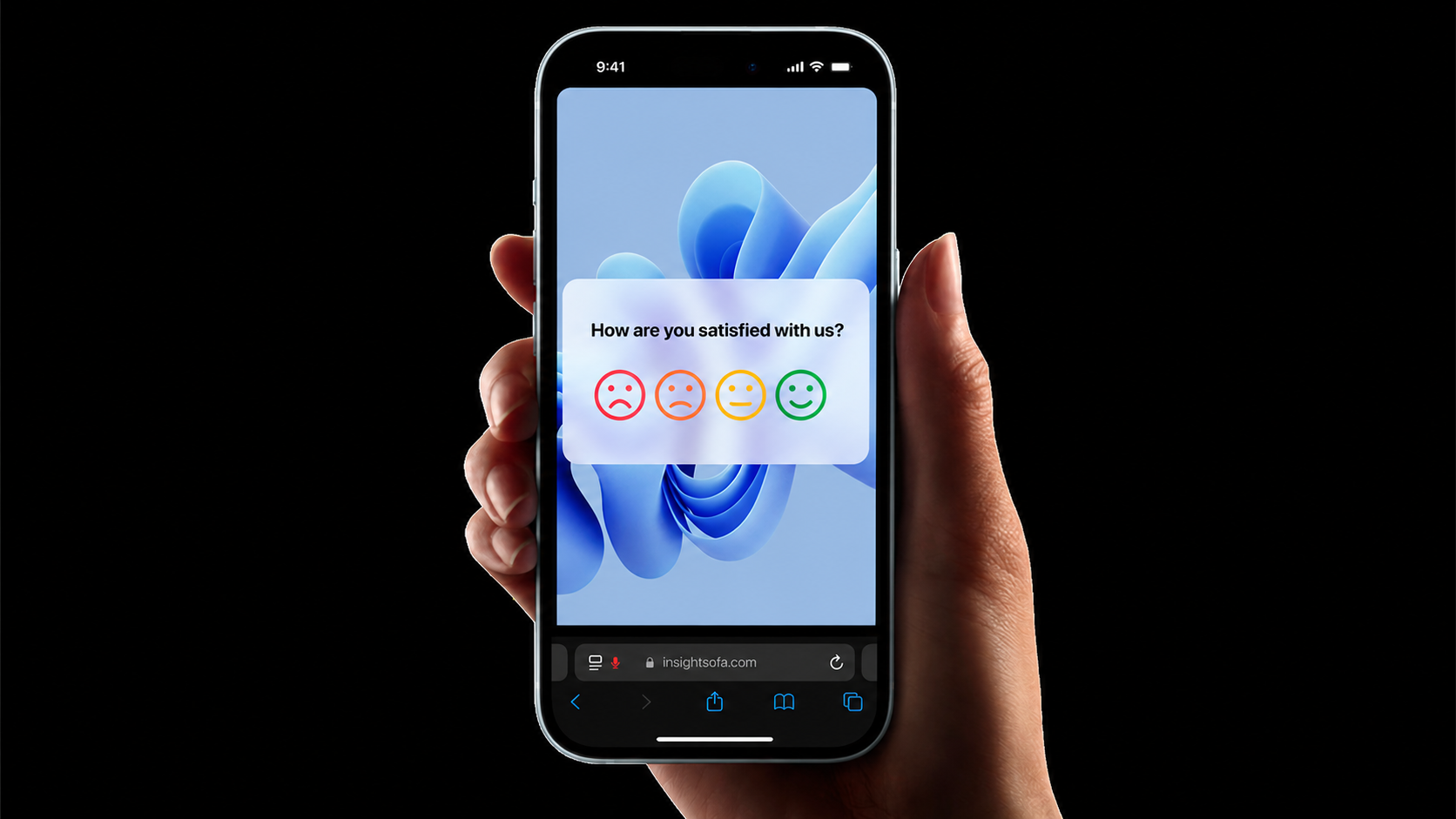
Traditional metrics of customer and employee experience—such as NPS (Net Promoter Score) or CSAT (Customer Satisfaction Score)—have one fundamental weakness: they reduce reality to a number. They say how much, but explain why less convincingly. It is precisely here that, in recent years, sentiment analysis of free-text comments has come to the forefront, which, thanks to advances in artificial intelligence, is fundamentally changing the way companies understand their customers and employees.
The mood trend report, as used for example by the InsightSofa platform, represents a shift from quantitative measurement to a deeper understanding of context. It is not just about whether a customer rates a service “eight out of ten,” but what language they use to talk about it—and what lies between the lines.
From questionnaires to natural language interpretation
Sentiment analysis is based on the ability of language models (LLMs – Large Language Models) to interpret natural language. These models are trained on extensive corpora of texts and are able to recognize not only the explicit meaning of words, but also context, irony, or ambivalence.
This is a fundamental difference compared to earlier methods that worked with keyword dictionaries. For example, the sentence “The product is great, but customer support disappointed me” was in the past difficult to classify. Modern models, however, can evaluate the prevailing sentiment—in this case rather negative.
According to a study by McKinsey (2023), companies that systematically analyze textual feedback using AI increase their ability to identify key causes of dissatisfaction up to 30% faster than organizations relying only on structured data.
Objectivity that a human cannot scale
One of the greatest benefits of AI in this area is consistency. A human analyst, however experienced, is subject to fatigue, context, and their own biases. A language model, by contrast, applies the same methodology to thousands of comments without deviations.
This has a fundamental impact on data quality. In its Voice of the Customer Analytics report (2024), Gartner states that inconsistent classification of feedback is among the three most common reasons why companies fail to effectively use customer data in decision-making.
InsightSofa addresses this problem with a standardized approach: each comment is classified into basic categories (positive, neutral, negative) and subsequently converted into a finer seven-level scale—from “very dissatisfied” to “very satisfied.” The resulting sentiment is then expressed as an arithmetic average.
This approach enables not only more accurate interpretation, but also easy tracking of trends over time.
Trend instead of a snapshot
One-time feedback has limited value. The real benefit comes when companies start to track sentiment as a dynamic indicator.
The mood trend report makes it possible to answer questions that are key to experience management:
- Is brand perception improving after a product change?
- How do customers respond to a new pricing strategy?
- Is employee satisfaction declining in a specific region?
It is precisely the time dimension that gives the data strategic significance. According to research by the Qualtrics XM Institute (2024), organizations that systematically track sentiment development achieve 20–25% higher customer retention than those that work only with one-time metrics.
The power of segmentation: why “average satisfaction” misleads
Aggregated data tend to conceal problems. A company may show a stable overall sentiment, while in a specific segment—for example for a particular product or region—there is a significant decline.
That is why it is crucial to work with segmentation. InsightSofa enables analysis of sentiment by products, branches, customer groups, or for example individual teams.
This approach corresponds to the recommendations of Bain & Company, who in their study on customer experience point out that “average satisfaction is one of the most misleading indicators in CX management because it masks variability between segments” (Bain, *Customer Experience Tools and Trends*, 2023).
From insight to action
Measuring sentiment alone is not enough. The key is the ability to transform data into concrete steps.
Rising sentiment can signal an opportunity—for example to support marketing or upsell. A declining trend, on the other hand, requires a quick response: analysis of causes, adjustment of processes, or targeted communication.
Companies’ experience shows that speed of response is decisive. According to PwC (Experience is everything, 2023), 32% of customers are willing to leave a brand after a single bad experience. Timely identification of negative sentiment is therefore not just an analytical exercise, but a risk management tool.
A new standard in experience management
Sentiment analysis of free-text comments is rapidly becoming a standard in the field of Customer Experience (CX) and Employee Experience (EX). Not because it is technologically attractive, but because it solves a long-term problem: the lack of context in decision-making.
Companies that learn to systematically work with sentiment gain a competitive advantage. Not only do they better understand their customers and employees, but they are also able to respond to their needs in real time.
And in an environment where experience determines loyalty and growth, this can be the difference between an average and a truly exceptional organization.